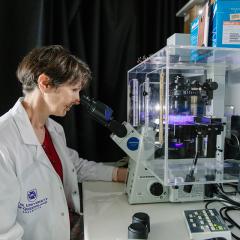
We study how and why certain neurons die in neurodegenerative diseases including Alzheimer’s disease and motor neuron disease (MND).
Our work is focused on the p75 neurotrophin receptor (p75NTR) and its role in neuronal loss, particularly the nerve cell degeneration that occurs in cholinergic neurons in the brain and spinal cord. Why cholinergic neurons of the basal forebrain die in Alzheimer’s disease, what contribution their loss makes to cognitive decline, whether manipulating neurotrophic signalling (NGF, BDNF, TrkA/B, p75) can protect or restore cognitive function, and what role the neurotrophins play in the normal function of these neurons are questions we are researching.
Cholinergic neurons in the basal forebrain are important for learning and memory, and post-mortem studies show that they can be selectively lost in AD. The current treatment for AD patients targets the function of these cholinergic neurons. However, significant loss of these neurons has already occurred in the majority of AD patients prior to treatment, and because these drugs are only efficacious while the neurons are alive, these treatments are of limited value to most patients. Better drugs are needed. Similarly, cholinergic neurons in the spinal cord selectively die in MND, causing loss of muscle tone and paralysis. No treatments are effective in treating the underlying cell loss in this debilitating condition.
Obstructive sleep apnoea (OSA) is a significant risk factor for the development of Alzheimer’s Disease. Using a novel mouse model of OSA, we have discovered that induced intermittent hypoxia during sleep causes cholinergic basal forebrain neurons to die, resulting in cognitive decline and increased amyloid beta accumulation, both hallmarks of AD. The lab is focused on the mechanism by which cBF neurons die in OSA, the specific consequences of the degeneration and ultimately aim to identify diagnostic elements for the treatment of AD.
The Coulson group has developed a candidate therapy (called c29) to try to stop the p75NTR death signalling pathway and promote cholinergic neuron survival. They have had success in a mouse model of MND, showing that a three-month c29 infusion could keep dying motor neurons alive for longer, and that treatment delayed disease onset. They further demonstrated that when mice were given the early-version drug, a cell survival signalling pathway was activated, and the cell death signalling pathway used by the p75 protein to kill dying motor neurons was blocked. In addition, collaborators from the University of Adelaide found that a by-product of p75 was found in high levels in people with MND, and could be measured in urine and blood. The c29 treated mice also showed less of this by-product, indicating that motor neuron degeneration was not being activated to the same extent.
Group leader

Professor Elizabeth Coulson
Group Leader, Neurotrophins in Alzheimer’s disease
Group Leader in Dementia Research, Clem Jones Centre for Ageing Dementia Research & Professor
+61 7 336 53034
elizabeth.coulson@uq.edu.au
UQ Researcher Profile
Our aim is to understand the causes and consequences of cholinergic basal forebrain neuron degeneration, with a focus on the role of neurotrophins in health and disease, in particular relating to dementia, with the long term objective to identify therapeutic strategies and compounds that can prevent or slow degeneration and cognitive impairment in humans.
-
delineation of p75 death signalling pathways
-
generation of genetically modified mice with modified p75 neurotrophin receptor function
-
generation and characterisation of a novel OSA mouse model
-
demonstration of a link between intermittent hypoxia and cholinergic basal forebrain neuron degeneration
-
development of a candidate therapy (called c29) that prevents p75NTR death signalling pathway and promotes cholinergic neuron survival in animal models of neurodegeneration.
The laboratory has expertise in neurotrophins and their signalling pathways, cholinergic basal forebrain neuron anatomy, function and manipulation, and in neurodegenerative disease particularly Alzheimer’s and motor neuron disease.
Martínez‐Mármol, Ramón, Chai, YeJin, Conroy, Jacinta N., Khan, Zahra, Hong, Seong‐Min, Kim, Seon Beom, Gormal, Rachel S., Lee, Dae Hee, Lee, Jae Kang, Coulson, Elizabeth J., Lee, Mi Kyeong, Kim, Sun Yeou and Meunier, Frédéric A. (2023). Hericerin derivatives activates a pan‐neurotrophic pathway in central hippocampal neurons converging to ERK1 /2 signaling enhancing spatial memory. Journal of Neurochemistry. doi: 10.1111/jnc.15767
Qian, Lei, Rawashdeh, Oliver, Kasas, Leda, Milne, Michael R., Garner, Nicholas, Sankorrakul, Kornraviya, Marks, Nicola, Dean, Matthew W., Kim, Pu Reum, Sharma, Aanchal, Bellingham, Mark C. and Coulson, Elizabeth J. (2022). Cholinergic basal forebrain degeneration due to sleep-disordered breathing exacerbates pathology in a mouse model of Alzheimer’s disease. Nature Communications, 13 (1) 6543, 1-18. doi: 10.1038/s41467-022-33624-y
Frailty and Treatment-Resistant Schizophrenia: A Retrospective Cohort Study
Pearson, Ella, Siskind, Dan, Hubbard, Ruth, Gordon, Emily, Coulson, Elizabeth, Arnautovska, Urska and Warren, Nicola (2022). Frailty and Treatment-Resistant Schizophrenia: A Retrospective Cohort Study. Community Mental Health Journal. doi: 10.1007/s10597-022-00998-8
Zhou, Xiaoqing Alice, Ngiam, Grace, Qian, Lei, Sankorrakul, Kornraviya, Coulson, Elizabeth J. and Chuang, Kai-Hsiang (2022). The basal forebrain volume reduction detected by MRI does not necessarily link with the cholinergic neuronal loss in the Alzheimer's Disease mouse model. Neurobiology of Aging, 117, 24-32. doi: 10.1016/j.neurobiolaging.2022.03.017
Xia, Ying, Eeles, Eamonn, Fripp, Jurgen, Pinsker, Donna, Thomas, Paul, Latter, Melissa, Doré, Vincent, Fazlollahi, Amir, Bourgeat, Pierrick, Villemagne, Victor L., Coulson, Elizabeth J. and Rose, Stephen (2022). Reduced cortical cholinergic innervation measured using [18F]-FEOBV PET imaging correlates with cognitive decline in mild cognitive impairment. NeuroImage: Clinical, 34 102992, 102992. doi: 10.1016/j.nicl.2022.102992
Shen, Wei-Yun, Luo, Cong, Hurtado, Plinio Reinaldo, Liu, Xiao-Jing, Luo, Ru-Yi, Li, Hui, Hu, Zhao-Lan, Xu, Jun-Mei, Coulson, Elizabeth J., Zhao, Ming, Zhou, Xin-Fu and Dai, Ru-Ping (2022). Up-regulation of proBDNF/p75NTR signaling in antibody-secreting cells drives systemic lupus erythematosus. Science Advances, 8 (3) eabj2797, eabj2797. doi: 10.1126/sciadv.abj2797
Sleep and circadian rhythms in Parkinson’s disease and preclinical models
Hunt, Jeremy, Coulson, Elizabeth J., Rajnarayanan, Rajendram, Oster, Henrik, Videnovic, Aleksandar and Rawashdeh, Oliver (2022). Sleep and circadian rhythms in Parkinson’s disease and preclinical models. Molecular Neurodegeneration, 17 (1) 2, 2. doi: 10.1186/s13024-021-00504-w
Frailty and severe mental illness: A systematic review and narrative synthesis
Pearson, Ella, Siskind, Dan, Hubbard, Ruth E., Gordon, Emily H., Coulson, Elizabeth and Warren, Nicola (2022). Frailty and severe mental illness: A systematic review and narrative synthesis. Journal of Psychiatric Research, 147, 166-175. doi: 10.1016/j.jpsychires.2022.01.014
High-affinity TrkA and p75 neurotrophin receptor complexes: a twisted affair
Conroy, Jacinta N. and Coulson, Elizabeth J. (2022). High-affinity TrkA and p75 neurotrophin receptor complexes: a twisted affair. Journal of Biological Chemistry, 298 (3) 101568, 101568. doi: 10.1016/j.jbc.2022.101568
Sankorrakul, Kornraviya, Qian, Lei, Thangnipon, Wipawan and Coulson, Elizabeth J (2021). Is there a role for the p75 neurotrophin receptor in mediating degeneration during oxidative stress and after hypoxia?. Journal of Neurochemistry, 158 (6) jnc.15451, 1-15. doi: 10.1111/jnc.15451
Fast-Trk(B)ing the mechanism of antidepressants
Conroy, Jacinta N., Jhaveri, Dhanisha J. and Coulson, Elizabeth J. (2021). Fast-Trk(B)ing the mechanism of antidepressants. Neuron, 109 (10), 1593-1595. doi: 10.1016/j.neuron.2021.04.027
Cholinergic regulation of adult hippocampal neurogenesis and hippocampus-dependent functions
Madrid, Lidia I., Jimenez-Martin, Javier, Coulson, Elizabeth J. and Jhaveri, Dhanisha J. (2021). Cholinergic regulation of adult hippocampal neurogenesis and hippocampus-dependent functions. The International Journal of Biochemistry & Cell Biology, 134 105969, 1-6. doi: 10.1016/j.biocel.2021.105969
Zhao, Yan, Coulson, Elizabeth J., Su, Xingli, Zhang, Junfeng, Sha, Baoyong, Xu, Hao, Deng, Yating, Chen, Yulong, Cao, Jian, Wang, Yunpeng and Wang, Shuang (2021). Identification of 14-3-3 epsilon as a regulator of the neural apoptotic pathway for chronic-stress-induced depression. iScience, 24 (2) 102043, 1-16. doi: 10.1016/j.isci.2021.102043
Kumar, Vinod, Lee, John D., Coulson, Elizabeth J. and Woodruff, Trent M. (2020). A validated quantitative method for the assessment of neuroprotective barrier impairment in neurodegenerative disease models. Journal of Neurochemistry, 158 (3) jnc.15119, 807-817. doi: 10.1111/jnc.15119
Edwards, Stephen R., Khan, Nemat, Coulson, Elizabeth J. and Smith, Maree T. (2020). Comparative studies of glial fibrillary acidic protein and brain‐derived neurotrophic factor expression in two transgenic mouse models of Alzheimer’s disease. Clinical and Experimental Pharmacology and Physiology, 47 (10) 1440-1681.13363, 1740-1750. doi: 10.1111/1440-1681.13363
Qin, Zuoheng, Gonsalvez, David G., Wood, Rhiannon J., Daemi, Fatemeh, Yoo, Sangwon, Ivanusic, Jason J., Coulson, Elizabeth J., Murray, Simon S. and Xiao, Junhua (2020). Partial deletion of p75NTR in large-diameter DRG neurons exerts no influence upon the survival of peripheral sensory neurons in vivo. Journal of Neuroscience Research, 98 (10) jnr.24665, 1987-1998. doi: 10.1002/jnr.24665
Groves, Natalie, O’Keeffe, Imogen, Lee, Wendy, Toft, Alexandra, Blackmore, Daniel, Bandhavkar, Saurabh, Coulson, Elizabeth J., Bartlett, Perry F. and Jhaveri, Dhanisha J. (2020). Blockade of TrkB but not p75 NTR activates a subpopulation of quiescent neural precursor cells and enhances neurogenesis in the adult mouse hippocampus. Developmental Neurobiology, 79 (9-10) dneu.22729, 868-879. doi: 10.1002/dneu.22729
Meier, Sonja, Alfonsi, Fabienne, Kurniawan, Nyoman D., Milne, Michael R., Kasherman, Maria A., Delogu, Alessio, Piper, Michael and Coulson, Elizabeth J. (2019). The p75 neurotrophin receptor is required for the survival of neuronal progenitors and normal formation of the basal forebrain, striatum, thalamus and neocortex. Development, 146 (18) dev181933, dev.181933. doi: 10.1242/dev.181933
Martínez-Mármol, Ramón, Mohannak, Nika, Qian, Lei, Wang, Tong, Gormal, Rachel S, Ruitenberg, Marc J, Vanhaesebroeck, Bart, Coulson, Elizabeth J and Meunier, Frédéric A (2019). p110δ PI 3-kinase inhibition perturbs APP and TNFα trafficking, reduces plaque burden, dampens neuroinflammation and prevents cognitive decline in an Alzheimer's disease mouse model. Journal of Neuroscience, 39 (40), 7976-7991. doi: 10.1523/JNEUROSCI.0674-19.2019
Ultrafast fMRI of the rodent brain using simultaneous multi-slice EPI
Lee, Hsu-Lei, Li, Zengmin, Coulson, Elizabeth J. and Chuang, Kai-Hsiang (2019). Ultrafast fMRI of the rodent brain using simultaneous multi-slice EPI. NeuroImage, 195, 48-58. doi: 10.1016/j.neuroimage.2019.03.045
Peripheral Nerve Regeneration Is Independent From Schwann Cell p75(NTR) Expression
Goncalves, Nadia P., Mohseni, Simin, El Soury, Marwa, Ulrichsen, Maj, Richner, Mette, Xiao, Junhua, Wood, Rhiannon J., Andersen, Olav M., Coulson, Elizabeth J., Raimondo, Stefania, Murray, Simon S. and Vaegter, Christian B. (2019). Peripheral Nerve Regeneration Is Independent From Schwann Cell p75(NTR) Expression. Frontiers in Cellular Neuroscience, 13 235, 235. doi: 10.3389/fncel.2019.00235
Milne, Michael R., Qian, Lei, Turnbull, Marion T., Kinna, Genevieve, Collins, Brett M., Teasdale, Rohan D. and Coulson, Elizabeth J. (2019). Downregulation of SNX27 expression does not exacerbate amyloidogenesis in the APP/PS1 Alzheimer's disease mouse model. Neurobiology of Aging, 77, 144-153. doi: 10.1016/j.neurobiolaging.2019.01.011
Boskovic, Zoran, Meier, Sonja, Wang, Yunpeng, Milne, Michael R., Onraet, Tessa, Tedoldi, Angelo and Coulson, Elizabeth J. (2019). Regulation of cholinergic basal forebrain development, connectivity, and function by neurotrophin receptors. Neuronal Signaling, 3 (1), NS20180066. doi: 10.1042/ns20180066
Boskovic, Zoran, Milne, Michael R., Qian, Lei, Clifton, Hamish D., McGovern, Alice E., Turnbull, Marion T., Mazzone, Stuart B. and Coulson, Elizabeth J. (2018). Cholinergic basal forebrain neurons regulate fear extinction consolidation through p75 neurotrophin receptor signaling. Translational Psychiatry, 8 (1) 199, 199. doi: 10.1038/s41398-018-0248-x
Qian, Lei, Milne, Michael R., Shepheard, Stephanie, Rogers, Mary-Louise, Medeiros, Rodrigo and Coulson, Elizabeth J. (2018). Removal of p75 neurotrophin receptor expression from cholinergic basal forebrain neurons reduces amyloid-β plaque deposition and cognitive impairment in aged APP/PS1 mice. Molecular Neurobiology, 56 (7), 4639-4652. doi: 10.1007/s12035-018-1404-2
Turnbull, Marion T., Boskovic, Zoran and Coulson, Elizabeth J. (2018). Acute Down-regulation of BDNF Signaling Does Not Replicate Exacerbated Amyloid-beta Levels and Cognitive Impairment Induced by Cholinergic Basal Forebrain Lesion. Frontiers in Molecular Neuroscience, 11 51, 1-13. doi: 10.3389/fnmol.2018.00051
May, Linda M., Anggono, Victor, Gooch, Helen M., Jang, Se E., Matusica, Dusan, Kerbler, Georg M., Meunier, Frederic A., Sah, Pankaj and Coulson, Elizabeth J. (2017). G-protein-coupled inwardly rectifying potassium (GIRK) channel activation by the p75 neurotrophin receptor is required for amyloid beta toxicity. Frontiers in Neuroscience, 11 (455) 455. doi: 10.3389/fnins.2017.00455
Coulson, Elizabeth J. and Bartlett, Perry F. (2017). An exercise path to preventing Alzheimer's disease : An Editorial Highlight on 'Exercise and BDNF reduce Ab production by enhancing alpha-secretase processing of APP'. Journal of Neurochemistry, 142 (2), 191-193. doi: 10.1111/jnc.14038
Turnbull, Marion T. and Coulson, Elizabeth J. (2017). Cholinergic basal forebrain lesion decreases neurotrophin signaling without affecting tau hyperphosphorylation in genetically susceptible mice. Journal of Alzheimer's Disease, 55 (3), 1141-1154. doi: 10.3233/JAD-160805
Wang, Tong, Martin, Sally, Nguyen, Tam H., Harper, Callista B., Gormal, Rachel S., Martinez-Marmol, Ramon, Karunanithi, Shanker, Coulson, Elizabeth J., Glass, Nick R., Cooper-White, Justin J., Van Swinderen, Bruno and Meunier, Frederic A. (2016). Flux of signalling endosomes undergoing axonal retrograde transport is encoded by presynaptic activity and TrkB. Nature Communications, 7 (1) 12976, 12976. doi: 10.1038/ncomms12976
Matusica, Dusan, Alfonsi, Fabienne, Turner, Bradley J., Butler, Tim J., Shepheard, Stephanie R., Rogers, Mary-Louise, Skeldal, Sune, Underwood, Clare K., Mangelsdorf, Marie and Coulson, Elizabeth J. (2016). Inhibition of motor neuron death in vitro and in vivo by a p75 neurotrophin receptor intracellular domain fragment. Journal of Cell Science, 129 (3), 517-530. doi: 10.1242/jcs.173864
Coulson, Elizabeth J. and Andersen, Olav M. (2015). The A-B-C for SORting APP. Journal of Neurochemistry, 135 (1), 1-3. doi: 10.1111/jnc.13231
Kerbler, Georg M., Nedelska, Zuzana, Fripp, Jurgen, Laczo, Jan, Vyhnalek, Martin, Lisy, Jiri, Hamlin, Adam S., Rose, Stephen, Hort, Jakub and Coulson, Elizabeth J. (2015). Basal forebrain atrophy contributes to allocentric navigation impairment in Alzheimer's disease patients. Frontiers in Aging Neuroscience, 7 (185) 185, 1-11. doi: 10.3389/fnagi.2015.00185
Basal forebrain atrophy correlates with amyloid beta burden in Alzheimer's disease
Kerbler, Georg M., Fripp, Jürgen, Rowe, Christopher C., Villemagne, Victor L., Salvado, Olivier, Rose, Stephen, Coulson, Elizabeth J. and Alzheimer's Disease Neuroimaging Initiative (2015). Basal forebrain atrophy correlates with amyloid beta burden in Alzheimer's disease. NeuroImage: Clinical, 7, 105-113. doi: 10.1016/j.nicl.2014.11.015
Edwards, Stephen R., Hamlin, Adam S., Marks, Nicola, Coulson, Elizabeth J. and Smith, Maree T. (2014). Comparative studies using the Morris water maze to assess spatial memory deficits in two transgenic mouse models Of Alzheimer's disease. Clinical and Experimental Pharmacology and Physiology, 41 (10), 798-806. doi: 10.1111/1440-1681.12277
The role of p75NTR in cholinergic basal forebrain structure and function
Boskovic, Zoran, Alfonsi, Fabienne, Rumballe, Bree A., Fonseka, Sachini, Windels, Francois and Coulson, Elizabeth J. (2014). The role of p75NTR in cholinergic basal forebrain structure and function. Journal of Neuroscience, 34 (39), 13033-13038. doi: 10.1523/JNEUROSCI.2364-14.2014
Matusica, Dusan and Coulson, Elizabeth J. (2014). Local versus long-range neurotrophin receptor signalling: Endosomes are not just carriers for axonal transport. Seminars in Cell and Developmental Biology, 31, 57-63. doi: 10.1016/j.semcdb.2014.03.032
A role for SNAREs in neuronal survival?
Harper, Callista B., Bademosi, Adekunle T., Coulson, Elizabeth J. and Meunier, Frederic A. (2014). A role for SNAREs in neuronal survival?. Journal of Neurochemistry, 129 (5), 753-755. doi: 10.1111/jnc.12699
Hort, J., Andel, R., Mokrisova, I., Gazova, I., Amlerova, J., Valis, M., Coulson, E. J., Harrison, J., Windisch, M. and Laczo, J. (2014). Effect of donepezil in alzheimer disease can be measured by a computerized human analog of the morris water maze. Neurodegenerative Diseases, 13 (2-3), 192-196. doi: 10.1159/000355517
Spatial navigation in young versus older adults
Gazova, Ivana, Laczo, Jan, Rubinova, Eva, Mokrisova, Ivana, Hyncicova, Eva, Andel, Ross, Vyhnalek, Martin, Sheardova, Katerina, Coulson, Elizabeth J. and Hort, Jakub (2013). Spatial navigation in young versus older adults. Frontiers in Aging Neuroscience, 5 (DEC) Article 94, 94.1-94.8. doi: 10.3389/fnagi.2013.00094
Up-regulation of sortilin mediated by amyloid-beta and p75NTR: safety lies in the middle course
Coulson, Elizabeth J and Nykjaer, Anders (2013). Up-regulation of sortilin mediated by amyloid-beta and p75NTR: safety lies in the middle course. Journal of Neurochemistry, 127 (2), 149-151. doi: 10.1111/jnc.12389
Matusica, Dusan, Skeldal, Sune, Sykes, Alex M., Palstra, Nickless, Sharma, Aanchal and Coulson, Elizabeth J. (2013). An intracellular domain fragment of the p75 neurotrophin receptor (p75 NTR) enhances tropomyosin receptor kinase A(TrkA) receptor function. Journal of Biological Chemistry, 288 (16), 11144-11154. doi: 10.1074/jbc.M112.436469
Martin, Sally, Harper, Callista B., May, Linda M., Coulson, Elizabeth J., Meunier, Frederic A. and Osborne, Shona L. (2013). Inhibition of PIKfyve by YM-201636 Dysregulates Autophagy and Leads to Apoptosis-Independent Neuronal Cell Death. PLoS One, 8 (3) e60152, e60152.1-e60152.14. doi: 10.1371/journal.pone.0060152
Structural basis for endosomal trafficking of diverse transmembrane cargos by PX-FERM proteins
Ghai, Rajesh, Bugarcic, Andrea, Liu, Huadong, Norwood, Suzanne J., Skeldal, Sune, Coulson, Elizabeth J., Li, Shawn Shun-Cheng, Teasdale, Rohan D. and Collins, Brett M. (2013). Structural basis for endosomal trafficking of diverse transmembrane cargos by PX-FERM proteins. Proceedings of the National Academy of Sciences of the United States of America, 110 (8), E643-E652. doi: 10.1073/pnas.1216229110
Lesions of the basal forebrain cholinergic system in mice disrupt idiothetic navigation
Hamlin, Adam S., Windels, Francois, Boskovic, Zoran, Sah, Pankaj and Coulson, Elizabeth J. (2013). Lesions of the basal forebrain cholinergic system in mice disrupt idiothetic navigation. PLoS ONE, 8 (1) e53472, e53472.1-e53472.9. doi: 10.1371/journal.pone.0053472
Sykes, Alex M., Palstra, Nick, Abankwa, Daniel, Hill, Justine M., Skeldal, Sune, Matusica, Dusan, Venkatraman, Prahatha, Hancock, John F. and Coulson, Elizabeth J. (2012). The effects of transmembrane sequence and dimerization on cleavage of the p75 neurotrophin receptor by γ-secretase. Journal of Biological Chemistry, 287 (52), 43810-43824. doi: 10.1074/jbc.M112.382903
Kerbler, Georg M., Hamlin, Adam S., Pannek, Kerstin, Kurniawan, Nyoman D., Keller, Marianne D., Rose, Stephen E. and Coulson, Elizabeth J. (2012). Diffusion-weighted magnetic resonance imaging detection of basal forebrain cholinergic degeneration in a mouse model. NeuroImage, 66, 133-141. doi: 10.1016/j.neuroimage.2012.10.075
Skeldal, Sune, Sykes, Alex M., Glerup, Simon, Matusica, Dusan, Palstra, Nickless, Autio, Henri, Boskovic, Zoran, Madsen, Peder, Castrén, Eero, Nykjaer, Anders and Coulson, Elizabeth J. (2012). Mapping of the interaction site between sortilin and the p75 neurotrophin receptor reveals a regulatory role for the sortilin intracellular domain in p75 neurotrophin receptor shedding and apoptosis. Journal of Biological Chemistry, 287 (52), 43798-43809. doi: 10.1074/jbc.M112.374710
Skeldal, S., Matusica, D., Nykjaer, A. and Coulson, E. J. (2012). Proteolytic processing of the p75 neurotrophin receptor: A prerequisite for signalling? (vol 33, pg 614, 2011). Bioessays, 34 (6), 521-521. doi: 10.1002/bies.201110036
Skeldal, Sune, Matusica, Dusan, Nykjaer, Anders and Coulson, Elizabeth J. (2011). Proteolytic processing of the p75 neurotrophin receptor: A prerequisite for signalling?: Neuronal life, growth and death signalling are crucially regulated by intra-membrane proteolysis and trafficking of p75(NTR). BioEssays, 33 (8), 614-625. doi: 10.1002/bies.201100036
Proctor, Dustin T., Coulson, Elizabeth J. and Dodd, Peter R. (2011). Post-synaptic scaffolding protein interactions with glutamate receptors in synaptic dysfunction and Alzheimer's disease. Progress in Neurobiology, 93 (4), 509-521. doi: 10.1016/j.pneurobio.2011.02.002
Proctor, Dustin T., Coulson, Elizabeth J. and Dodd, Peter R. (2010). Reduction in post-synaptic scaffolding PSD-95 and SAP-102 protein levels in the Alzheimer inferior temporal cortex is correlated with disease pathology. Journal of Alzheimer's Disease, 21 (3), 795-811. doi: 10.3233/JAD-2010-100090
Aβ₁₋₄₂ stimulates adult SVZ neurogenesis through the p75 neurotrophin receptor
Sotthibundhu, Areechun, Li, Qiao-Xin, Thangnipon, Wipawan and Coulson, Elizabeth J. (2009). Aβ₁₋₄₂ stimulates adult SVZ neurogenesis through the p75 neurotrophin receptor. Neurobiology of Aging, 30 (12), 1975-1985. doi: 10.1016/j.neurobiolaging.2008.02.004
p75 neurotrophin receptor regulates basal and fluoxetine-stimulated hippocampal neurogenesis
Colditz, Michael J., Catts, Vibeke S., Al-menhali, Noura, Osborne, Geoffrey W., Bartlett, Perry F. and Coulson, Elizabeth J. (2009). p75 neurotrophin receptor regulates basal and fluoxetine-stimulated hippocampal neurogenesis. Experimental Brain Research, 200 (2), 161-167. doi: 10.1007/s00221-009-1947-6
The role of the p75 neurotrophin receptor in cholinergic dysfunction in Alzheimer's disease
Coulson, Elizabeth, May, Linda, Sykes, Alexander and Hamlin, Adam (2009). The role of the p75 neurotrophin receptor in cholinergic dysfunction in Alzheimer's disease. Neuroscientist, 15 (4), 317-323. doi: 10.1177/1073858408331376
The p75 neurotrophin receptor regulates hippocampal neurogenesis and related behaviours
Catts, Vibeke, Al-Minhali, Noura, Burne, Thomas H.J., Colditz, Michael and Coulson, Elizabeth (2008). The p75 neurotrophin receptor regulates hippocampal neurogenesis and related behaviours. European Journal of Neuroscience, 28 (5), 883-892. doi: 10.1111/j.1460-9568.2008.06390.x
β-amyloid1-42 induces neuronal death through the p75 neurotrophin receptor
Sotthibundhu, Areechun, Sykes, Alex M., Fox, Briony, Underwood, Clare K., Thangnipon, Wipawan and Coulson, Elizabeth, J. (2008). β-amyloid1-42 induces neuronal death through the p75 neurotrophin receptor. The Journal of Neuroscience, 28 (15), 3941-3946. doi: 10.1523/JNEUROSCI.0350-08.2008
Underwood, Clare K., Reid, Kate, May, Linda M., Bartlett, Perry F. and Coulson, Elizabeth J. (2008). Palmitoylation of the C-terminal fragment of p75NTR regulates death signaling and is required for subsequent cleavage by gamma-secretase. Molecular and Cellular Neuroscience, 37 (2), 346-358. doi: 10.1016/j.mcn.2007.10.005
Coulson, E. J., May, L. M., Osborne, S. L., Reid, K., Underwood, C. K., Meunier, F. A., Bartlett, P. F. and Sah, P. (2008). p75 neurotrophin receptor mediates neuronal cell death by activating GIRK channels through phosphatidylinositol 4,5-bisphosphate. Journal of Neuroscience, 28 (1), 315-324. doi: 10.1523/JNEUROSCI.2699-07.2008
Underwood, Clare K. and Coulson, Elizabeth J. (2008). The p75 neurotrophin receptor. The International Journal of Biochemistry and Cell Biology, 40 (9), 1664-1668. doi: 10.1016/j.biocel.2007.06.010
Copper induced oxidation of serotonin: analysis of products and toxicity
Jones, C. E., Underwood, C. K., Coulson, E. J. and Taylor, P. J. (2007). Copper induced oxidation of serotonin: analysis of products and toxicity. Journal of Neurochemistry, 102 (4), 1035-1043. doi: 10.1111/j.1471-4159.2007.04602.x
Zinc-mediated neuronal death is dependent on Trk activation
Morley, Samuel N., Power, John M., Coulson, Elizabeth J. and Bartlett, Perry F. (2007). Zinc-mediated neuronal death is dependent on Trk activation. Experimental Neurology, 205 (2), 360-366. doi: 10.1016/j.expneurol.2007.02.006
Young, K. M., Merson, T. D., Sotthibundhu, A., Coulson, E. J. and Bartlett, P. F. (2007). p75 Neurotrophin receptor expression defines a population of BDNF-responsive neurogenic precursor cells. Journal of Neuroscience, 27 (19), 5146-5155. doi: 10.1523/JNEUROSCI.0654-07.2007
Apoptosis and schizophrenia: a pilot study based on dermal fibroblast cell lines
Catts, Vibeke Sorensen, Catts, Stanley Victor, McGrath, John Joseph, Feron, Francois, McLean, Duncan, Coulson, Elizabeth Jane and Lutze-Mann, Louise Helen (2006). Apoptosis and schizophrenia: a pilot study based on dermal fibroblast cell lines. Schizophrenia Research, 84 (1), 20-28. doi: 10.1016/j.schres.2006.03.016
Does the p75 neurotrophin receptor mediate A beta-induced toxicity in Alzheimer's disease?
Coulson, Elizabeth J. (2006). Does the p75 neurotrophin receptor mediate A beta-induced toxicity in Alzheimer's disease?. Journal of Neurochemistry, 98 (3), 654-660. doi: 10.1111/j.1471-4159.2006.03905.x
Young, Kaylene M., Bartlett, Perry F. and Coulson, Elizabeth J. (2006). Neural progenitor number is regulated by nuclear factor-kappa B p65 and p50 subunit-dependent proliferation rather than cell survival. Journal of Neuroscience Research, 83 (1), 39-49. doi: 10.1002/jnr.20702
Tertiapin-Q blocks recombinant and native large conductance K+ channels in a use-dependent manner
Kanjhan, R., Coulson, E. J., Adams, D. J. and Bellingham, M. C. (2005). Tertiapin-Q blocks recombinant and native large conductance K+ channels in a use-dependent manner. Journal of Pharmacology And Experimental Therapeutics, 314 (3), 1353-1361. doi: 10.1124/jpet.105.085928
A microarray study of post-mortem mRNA degradation in mouse brain tissue
Catts, V. S., Catts, S. V., Fernandez, H. R., Taylor, J. M., Coulson, E. J. and Lutze-Mann, L. H. (2005). A microarray study of post-mortem mRNA degradation in mouse brain tissue. Molecular Brain Research, 138 (2), 164-177. doi: 10.1016/j.molbrainres.2005.04.017
Murray, SS, Bartlett, PF, Lopes, EC, Coulson, EJ, Greferath, U and Cheema, SS (2003). Low-affinity neurotrophin receptor with targeted mutation of exon 3 is capable of mediating the death of axotomized neurons. Clinical And Experimental Pharmacology And Physiology, 30 (4), 217-222. doi: 10.1046/j.1440-1681.2003.03827.x
Jabbour, AM, Ekert, PG, Coulson, EJ, Knight, MJ, Ashley, DM and Hawkins, CJ (2002). The p35 relative, p49, inhibits mammalian and Drosophila caspases including DRONC and protects against apoptosis. Cell Death And Differentiation, 9 (12), 1311-1320. doi: 10.1038/sj.cdd.4401135
Inhibitor of apoptosis proteins and their relatives: IAPs and other BIRPs
Verhagen, A. M., Coulson, E. J. and Vaux, D. L. (2001). Inhibitor of apoptosis proteins and their relatives: IAPs and other BIRPs. Genome Biology, 2 (7) 3009
Lowry, KS, Murray, SS, Coulson, EJ, Epa, R, Bartlett, PF, Barrett, G and Cheema, SS (2001). Systemic administration of antisense p75(NTR) oligodeoxynucleotides rescues axotomised spinal motor neurons. Journal of Neuroscience Research, 64 (1), 11-17. doi: 10.1002/jnr.1048
Chopper, a new death domain of the p75 neurotrophin receptor that mediates rapid neuronal cell death
Coulson, E. J., Reid, K., Baca, M., Shipham, K. A., Hulett, S. M., Kilpatrick, T. J. and Bartlett, P. F. (2000). Chopper, a new death domain of the p75 neurotrophin receptor that mediates rapid neuronal cell death. Journal of Biological Chemistry, 275 (39), 30537-30545. doi: 10.1074/jbc.M005214200
Our approach
We use a range of techniques in our research including molecular and cellular biology, animal models, histology, neuronal network tracing, mouse cognitive testing and small animal MRI. In addition, we have selected projects that involve human participants or the analysis of human cohort data.
Research areas
- Neurodegenerative disease
- Nerve cell survival
- P75NTR biology
- Regulation of neurodegeneration
- Sleep disruption and Alzheimer’s Disease
Latest news
-
-
UQ study explains link between sleep apnoea and dementia
9 November 2022 -
Can treating sleep apnoea reduce dementia risk?
1 February 2018